
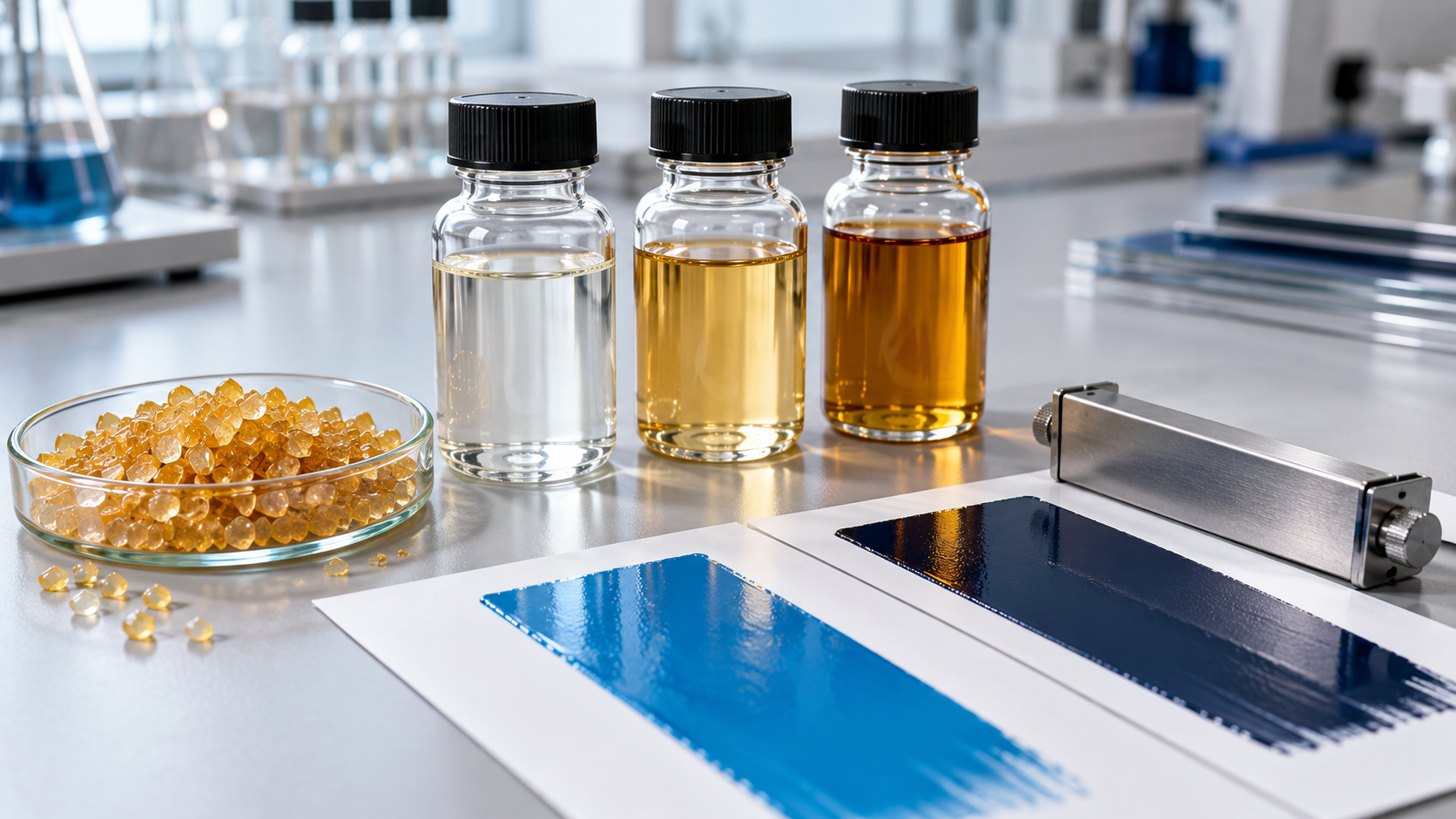
How to Evaluate Resin Compatibility in Solvent-Based Inks
A resin can dissolve in a solvent and still cause problems when it enters an ink formulation. A useful evaluation checks the clear binder blend, the pigmented ink and the printed film before a candidate moves to a press trial.
For formulators considering a new resin grade or an alternative supplier, the goal is a repeatable comparison with the current formulation. This guide proposes a practical screening workflow for solvent-based flexographic and gravure inks. Use it alongside the grade-specific technical data sheet and your application requirements.
Solubility and compatibility answer different questions
Solubility concerns whether a resin dissolves in the selected solvent blend under defined conditions. Binder compatibility concerns how the candidate behaves with the other resins in the formulation. Ink performance concerns the complete system, including pigments, additives, substrate and drying conditions.
Supplier literature treats solvent solubility and compatibility with main binders as separate selection factors; see Evonik’s technical background on co-binders. A clear resin solution is therefore a useful starting point, but it is not sufficient evidence that the finished ink will meet its performance targets.
1. Define the comparison before mixing
Start with a control formulation that already has documented performance. Write down the problem you want the new resin to solve, such as an adhesion target, a viscosity constraint or an alternative sourcing requirement. Agree on the acceptance criteria before reviewing results.
- Materials: primary binder and candidate grade, batch identification, pigments and additives.
- Composition: solvent identities and proportions, total nonvolatile content and candidate resin level, with the calculation basis stated.
- Process: addition sequence, mixing conditions, measurement temperature and any dilution before testing.
- Application: print process, substrate grade and surface treatment, target film weight and drying conditions.
For an initial resin comparison, hold total binder solids and the solvent blend constant where practical. If the candidate arrives as a solution, include its carrier solvent in the calculation. Later, assess each viable formulation at its intended press viscosity and record the dilution required. These two comparisons answer different questions.
2. Screen the clear binder blend
First prepare the candidate in the intended solvent system, following the supplier’s dissolution guidance. Then combine it with the primary binder at the proposed ratio. Keep a reference sample without the candidate and label every mixture with its composition and preparation conditions.
Check for incomplete dissolution, unexpected haze, particles, gel formation or separation. Observe the blend after preparation and again after the storage conditions defined in your test plan. Haze may indicate a compatibility issue, but incomplete dissolution, moisture or contamination should also be investigated before assigning a cause.
Use the actual solvent mixture rather than relying on a result in one convenient solvent. Eastman’s solvent selection resources distinguish resin solvency from evaporation behavior, both of which matter when choosing a blend. Set mixing, temperature and storage conditions from the relevant technical and safety data and your approved laboratory procedures; there is no universal recipe for every resin grade.
3. Repeat the assessment in the complete ink
A satisfactory clear blend should progress to the pigmented formulation. Keep pigment loading, dispersion procedure and additive levels controlled so that an unexplained change is easier to investigate. Record viscosity with the same instrument, method and temperature, and compare both fresh and stored samples.
Pigment stabilization adds another interaction: BYK explains that the stabilizing segments of polymeric dispersants need compatibility with the surrounding binder solution to function effectively. This is why clear-blend screening cannot replace evaluation of the full pigment–binder–additive system. See BYK’s explanation of deflocculating additives.
Look for changes in dispersion quality, sedimentation, separation, color strength and application behavior. Do not use transparency as an acceptance criterion for an intentionally opaque ink. Likewise, a lower viscosity or higher gloss alone does not establish compatibility or justify approval.
4. Check the printed and dried film
Apply the control and candidate inks to the intended substrate using comparable film weight and drying conditions. Evaluate the properties required by the job: appearance, adhesion, rub resistance, flexibility, blocking resistance and any relevant resistance to the expected end-use environment. Record the test method, conditioning period and acceptance limit for each property.
Include press behavior in the next validation stage. Sun Chemical’s technical discussion of solvent–ink parameters identifies drying behavior and resolubility as factors in flexographic printing defects. A successful laboratory drawdown should therefore lead to a controlled application trial, with observations of ink transfer, drying and restart behavior.
A compact record for each candidate
Use the same record for the control and every candidate. Choose the actual limits and observation intervals for your formulation rather than adopting generic pass/fail numbers.
| Stage | What to record | Decision |
|---|---|---|
| Clear binder blend | Composition, preparation conditions, appearance and storage observations | Proceed or investigate dissolution and blend stability |
| Complete ink | Solids, viscosity method, dispersion observations and changes after storage | Compare against the control and agreed limits |
| Printed film | Substrate, film weight, drying conditions and application test results | Confirm the required property balance |
| Press trial | Dilution, transfer, drying, restart behavior and relevant converting results | Approve for the defined application or revise |
What buyers should request from a resin supplier
Ask for the current grade-specific TDS and SDS, supply form and solids content, suggested solvent systems, dissolution guidance and recommended application scope. Request a representative sample and clarify which properties are typical values and which are supplied specifications. Similar product names or softening points should not be treated as proof that two grades are interchangeable.
When evaluating Most Chemical aldehyde ketone resins, share the primary binder, solvent blend, pigment system, substrate and target properties. This gives the technical discussion a clear starting point for grade selection and sample evaluation. For an earlier-stage overview, read How to Choose the Right Resin for Printing Inks.
Planning a resin comparison? Request a sample or send your formulation requirements to Most Chemical.



One Comment