Industrial Coating Resins: How to Improve Performance
Industrial coating resins shape film formation, adhesion, gloss, hardness, flexibility, drying behavior and resistance. The best choice is not the grade with the highest value on one data-sheet line; it is the resin system that delivers the required balance on the real substrate and under the actual application and service conditions.
A high-performance resin should therefore be evaluated as part of the complete formulation rather than as an isolated raw material. Its compatibility with solvents, pigments, additives, substrates and application conditions ultimately determines coating performance.
DEFINE THE SERVICE ENVIRONMENT
Start with substrate and exposure
Identify the real substrate, pretreatment, application method, cure window and expected exposure to water, solvents, heat, weathering or cleaners before screening resin grades.
BALANCE, DO NOT MAXIMIZE
Hardness, flexibility and cure
Higher hardness, gloss or cure speed is not automatically better. Optimize the property set as a system, then validate adhesion, appearance, durability and process stability together.
How to Select Industrial Coating Resins
The resin forms the continuous phase of the dried coating film. It binds pigments and additives together, adheres the coating to the substrate and helps determine how the finished surface responds to physical and chemical exposure.
Even when two resins appear similar in their technical specifications, they may behave differently in an actual formulation. Differences in molecular structure, solubility, softening point and compatibility can affect processing as well as final performance.
For this reason, resin selection should begin with the required application performance rather than price or a single technical parameter.
1. Adhesion to the Substrate
Coatings must establish sufficient adhesion to substrates such as metal, wood, plastic, paper or previously coated surfaces.
Poor resin–substrate compatibility can lead to peeling, cracking or loss of adhesion after drying. Substrate surface energy, cleanliness, pretreatment and curing conditions can also influence the result.
When evaluating a resin, formulators should conduct adhesion tests on the actual production substrate instead of relying only on laboratory glass panels.
2. Gloss and Surface Appearance
Resin compatibility affects pigment wetting, film leveling and surface smoothness. A well-selected resin can help produce a uniform coating film with improved gloss and visual clarity.
Poor compatibility may result in haze, reduced gloss, floating, flooding or an uneven surface. These problems are especially noticeable in high-gloss industrial coatings and pigmented systems.
Aldehyde ketone resins are often evaluated as modifying resins when formulators need to improve gloss, pigment wetting, hardness or overall film appearance. “Ketone resin” and “ketone–aldehyde resin” are commonly used as related market names rather than as separate performance categories. Performance depends on the complete formulation and the specific grade.
3. Hardness and Flexibility
Coating hardness and flexibility must be balanced according to the final application.
A harder film may provide better scratch resistance and surface durability, but excessive hardness can reduce flexibility and increase the risk of cracking. A more flexible coating may perform better on moving or deformable substrates, although it may offer lower surface hardness.
The correct resin combination should provide enough hardness for protection while maintaining the flexibility required by the substrate and end-use conditions.
4. Drying and Film Formation
Resin solubility and solvent release can affect coating viscosity, application behavior and drying speed.
A resin that is not fully compatible with the solvent system may produce haze, precipitation or unstable viscosity. Excessively fast solvent release can also cause poor leveling, while slow release may increase drying time and reduce production efficiency.
Formulators should evaluate solution clarity, viscosity stability, application flow and film formation under realistic temperature and humidity conditions.
5. Chemical and Environmental Resistance
Industrial coatings may be exposed to water, solvents, cleaners, oils, heat, weathering or other chemicals.
The resin system should be selected according to the expected service environment. In some applications, a thermoplastic resin may provide the required film properties. In others, a crosslinking resin system may be needed to improve hardness, heat resistance or chemical resistance.
Amino resins function as reactive crosslinkers in compatible heat-curing systems; they are not interchangeable with thermoplastic modifying resins. Reactive-group balance, catalyst response, bake conditions, flexibility and storage stability should be evaluated with the primary binder.
Key Factors to Evaluate
Before selecting a resin for an industrial coating, consider the following factors:
- Substrate type and surface treatment
- Solvent system and resin solubility
- Pigment and additive compatibility
- Required gloss and appearance
- Adhesion, hardness and flexibility
- Drying or curing conditions
- Chemical and weather resistance
- Application method and target viscosity
- Storage stability of the finished coating
- Regulatory and end-use requirements
No single resin provides the best performance in every coating system. The most suitable option is the resin that delivers the required balance of properties within the complete formulation.
Recommended Laboratory Evaluation
A structured laboratory evaluation can reduce formulation risk before production trials.
Recommended checks include:
- Resin solution clarity and compatibility
- Viscosity and storage stability
- Pigment wetting and dispersion behavior
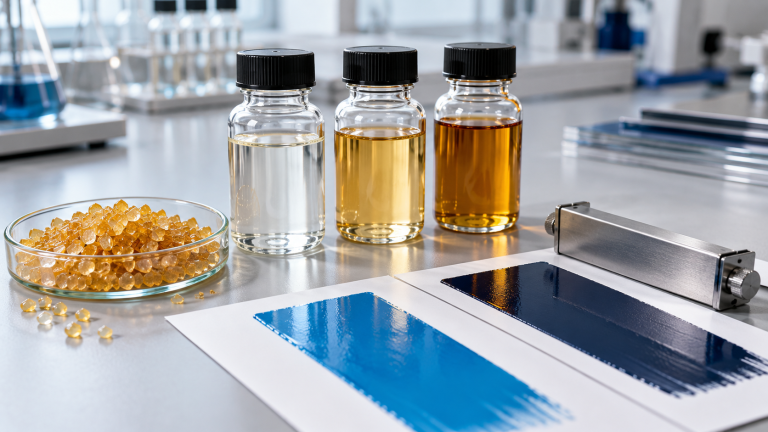
- Drawdown appearance and leveling
- Gloss and color development
- Adhesion to the intended substrate
- Hardness and flexibility
- Water, solvent and chemical resistance
- Drying or curing performance
- Comparison with the current resin system
Whenever possible, testing should use the actual pigments, solvents, additives, substrates and application conditions used in production.
Where appropriate, use ISO 2409 for cross-cut classification and ISO 2813 for specular gloss measurement, then define application-specific acceptance criteria.
Improving Performance Through Resin Modification
In many formulations, the goal is not to replace the primary binder completely. A specialty modifying resin may be introduced to improve selected properties such as gloss, adhesion, hardness, pigment wetting or drying behavior.
Aldehyde ketone and polyamide resins may serve as binders or modifiers in compatible formulation spaces, while amino resins serve a reactive crosslinking role. The appropriate choice depends on the coating chemistry, application method, cure mechanism and required end-use performance. Related formulation variables are covered in our guide to resin selection for printing inks.
Small-scale compatibility and application testing should always be completed before adjusting the production formulation.
Conclusion
Selecting industrial coating resins begins with understanding the relationship between the resin, the complete formulation and the final application. A well-matched resin can support adhesion, film formation, gloss, durability and process stability, but selection should be verified under realistic application conditions rather than from a technical data sheet alone.
Most Chemical supports customers with application-oriented resin recommendations and sample evaluation for industrial coatings and printing inks. For packaging-related coating requirements, see our guide to resin solutions for sustainable packaging applications.
Discuss your coating formulation
Share the substrate, binder system, cure conditions, performance targets and current formulation challenges with our technical team.